R-lens: Making J-lens More Faithful on Early Layers
R-Lens
The problem with J-Lens: we want the contribution of \(h_\ell\) to the output \(h_L\), which is not exactly the same as the Jacobian \(\frac{\partial h_L}{\partial h_\ell}\)., which is how a delta to \(h_\ell\) would get propagated to \(h_L\), not how the entirety of \(h_\ell\) contributes to \(h_L\)
Notably, the two concepts are aligned for linear layers, but not for other nonlinear layers, which look of the form \(y = C(x) x\). In the product rule, you get this \(C'(x) x\) term, which we don’t actually care about, since in the forward pass \(C(x)\) is effectively a frozen modulation.
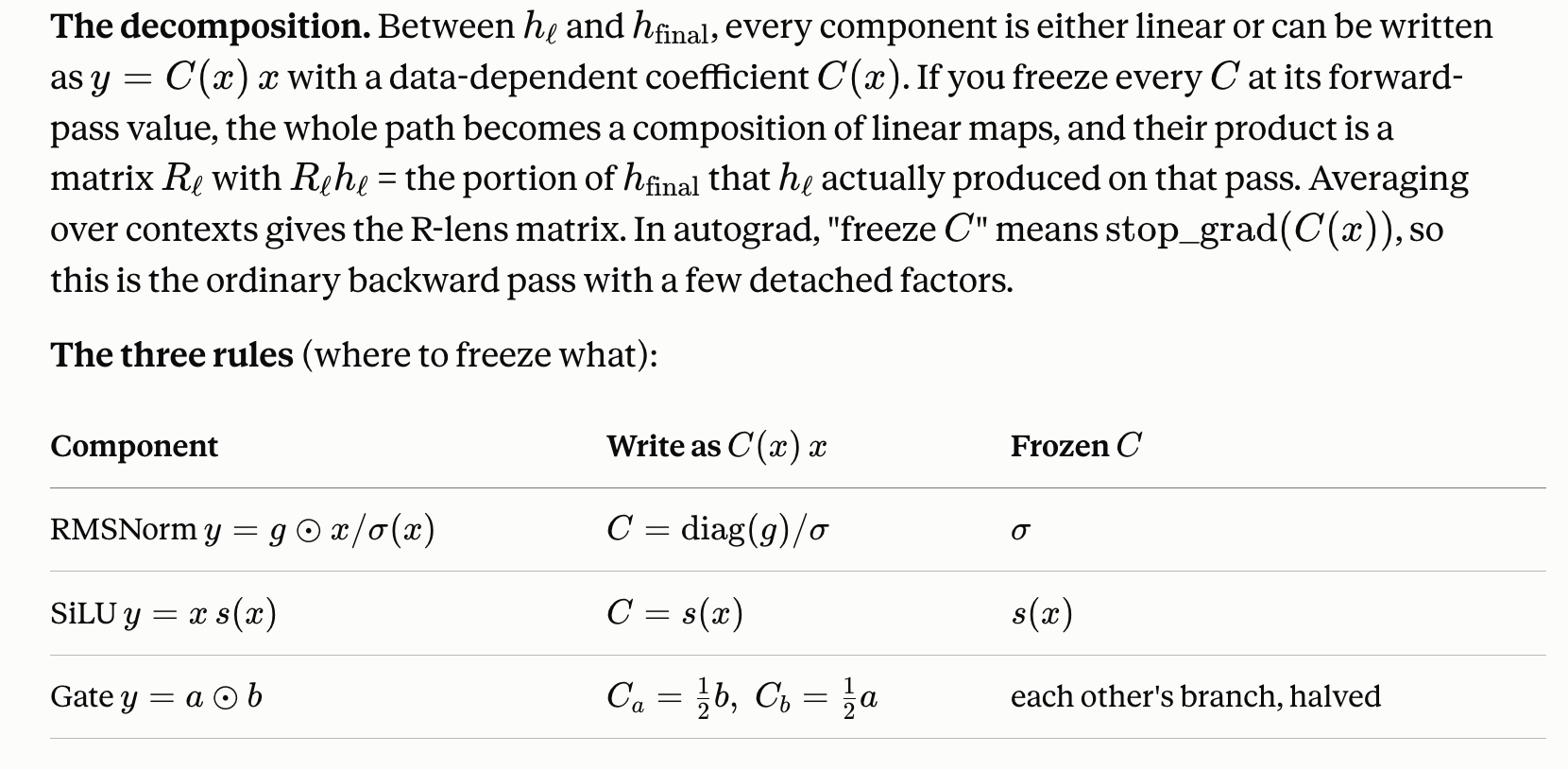
- so we just add these three stopgrad changes to components when calculating the Jacobian for J-lens
Further justification of why the Jacobian is wrong
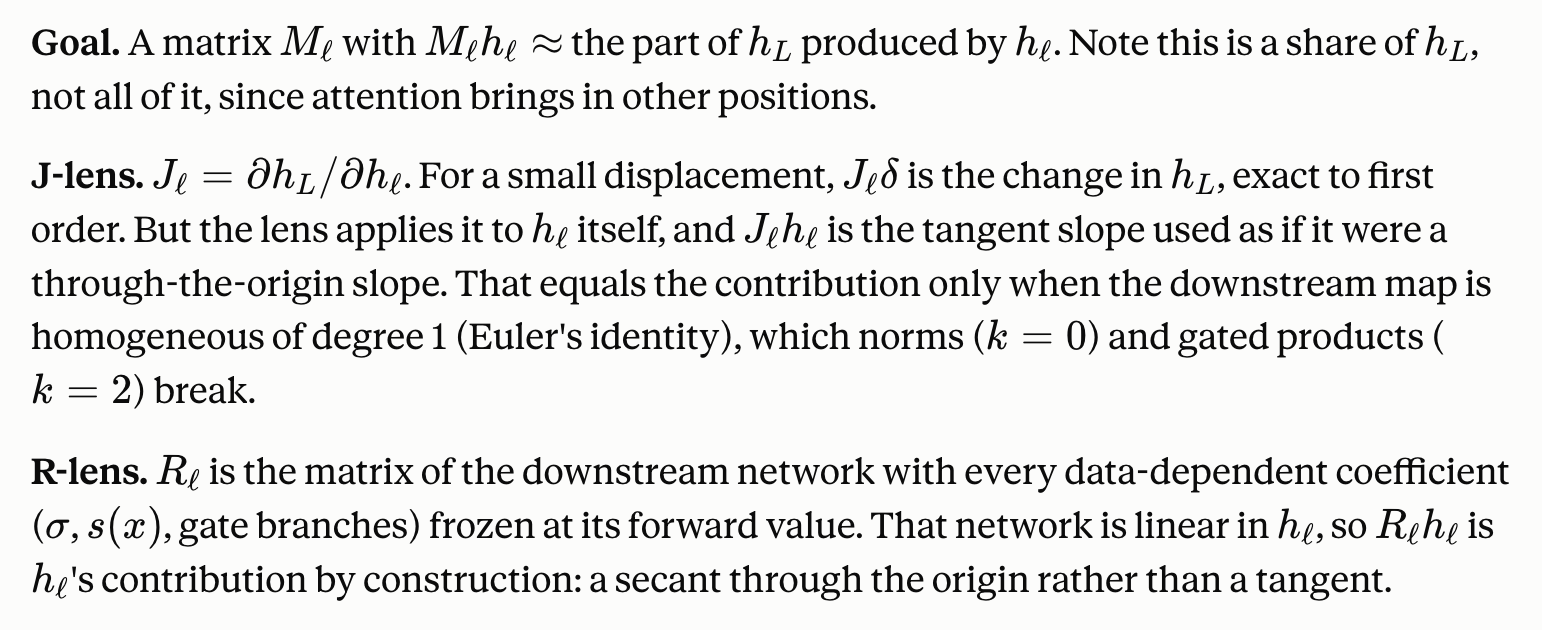
Note 1: Unlike the tangent (Jacobian), the secant is not unique. Tuned Lens is essentially another secant, that least squares predicts \(h_L\) using \(h_\ell\) but it suffers from ignoring the model’s computational pathways and thus being correlational and not causal
Note 2: attributing “contribution of \(h_\ell\) to \(h_L\)” is a separate problem from estimating the secant. Tuned Lens doesn’t try to estimate it at all and just uses \(h_L\) directly, R-Lens uses this frozen gradient method. One could try doing this secant estimation with Integrated Gradients as a more principled R-Lens
Experiments
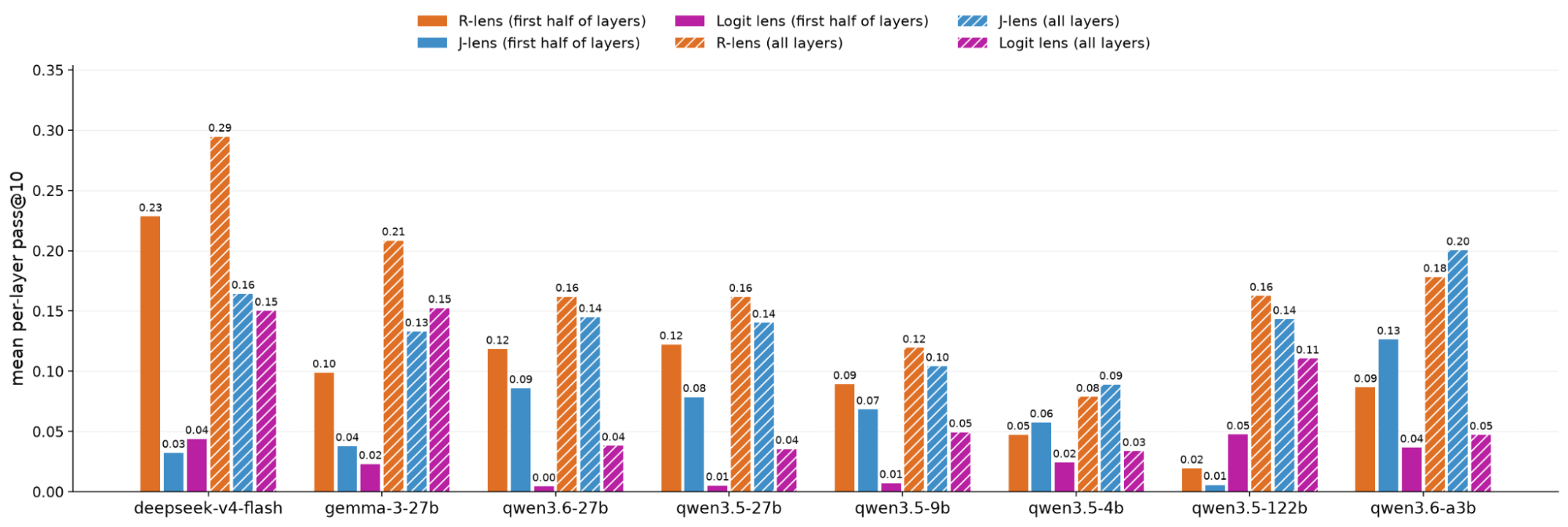
- matters more as the models get bigger. It doesn’t matter at all at the 4B scale
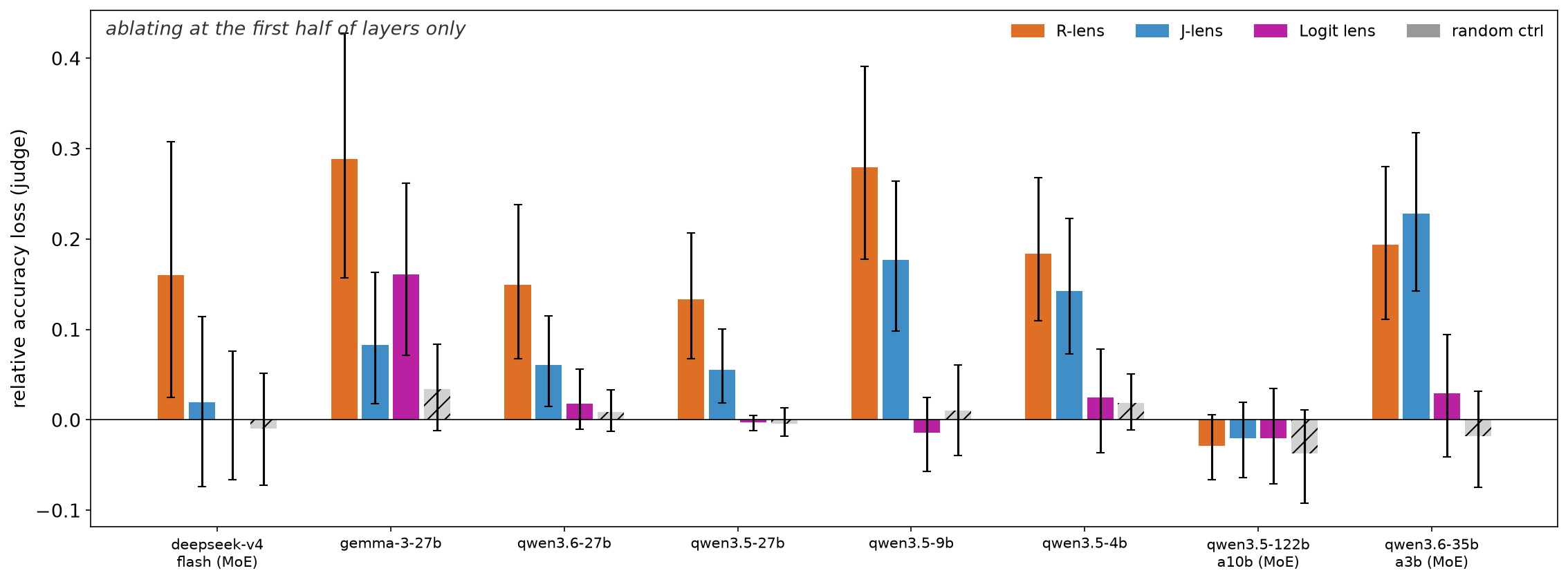
- seems more effective at causal intervention even at 4B though
The fact that they get reasonable outputs in early layers kinda calls into question the J-space paper’s localizing the workspace into middle layers thing.
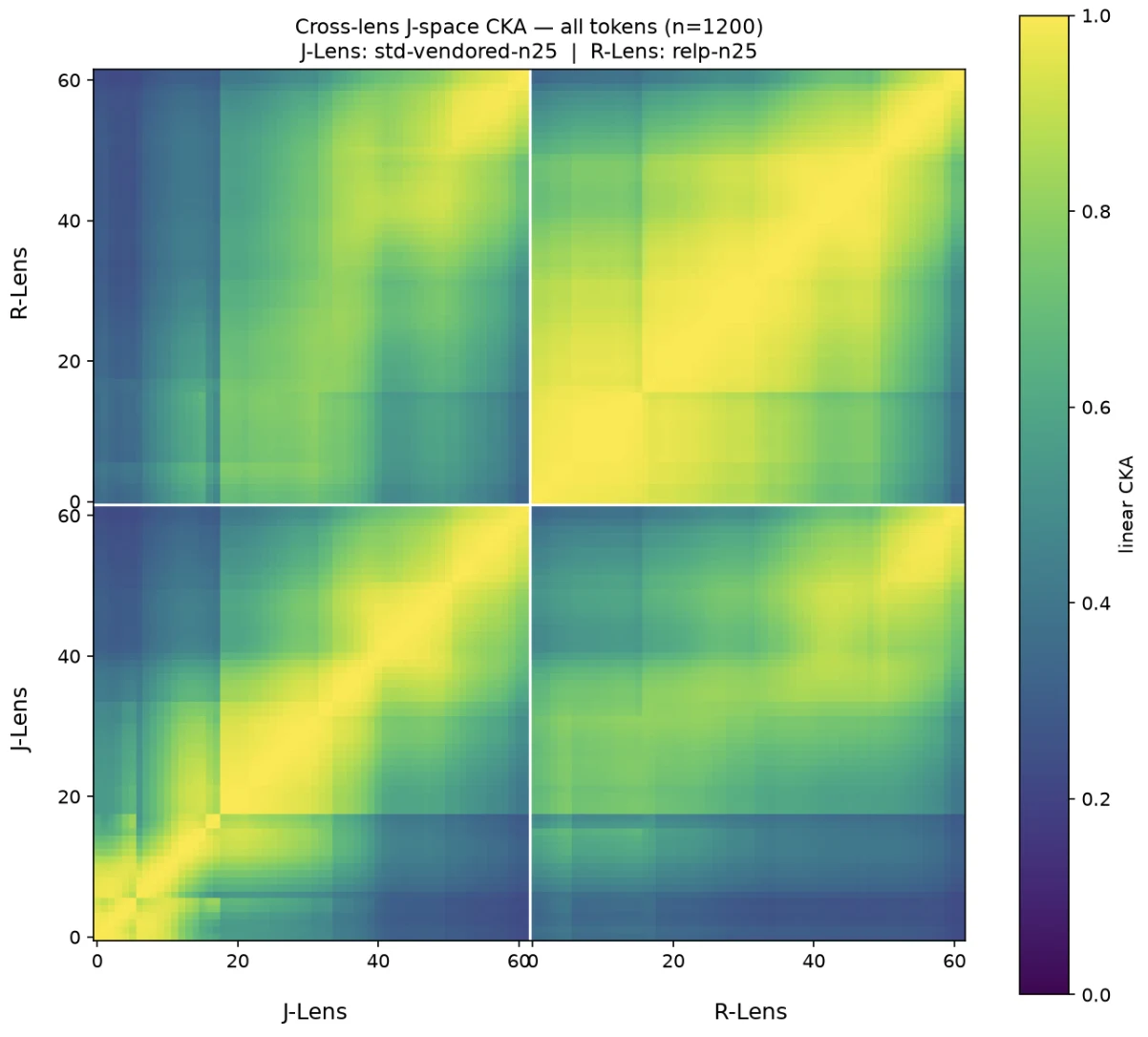
- the CKP similarity matrix (only look at bottom left square and upper right square) for J-Lens vs R-Lens.